
Neu5Gc in red meat is the newest reason people are taking a second look at their burger habit. In late 2026, a French research team linked this little-known sugar molecule to a higher risk of type 2 diabetes, and the headline “63% higher diabetes risk” spread fast online.
But what is Neu5Gc? Why does it matter that humans cannot make it? And should you panic about your Sunday roast?
The short answer: no panic needed. The study is early and observational. It does not prove that Neu5Gc causes diabetes. Still, it adds a new piece to a much bigger picture. For years, large studies have tied high red and processed meat intake to type 2 diabetes. Swapping some of that meat for beans, lentils, nuts and tofu is one of the best-supported changes you can make.
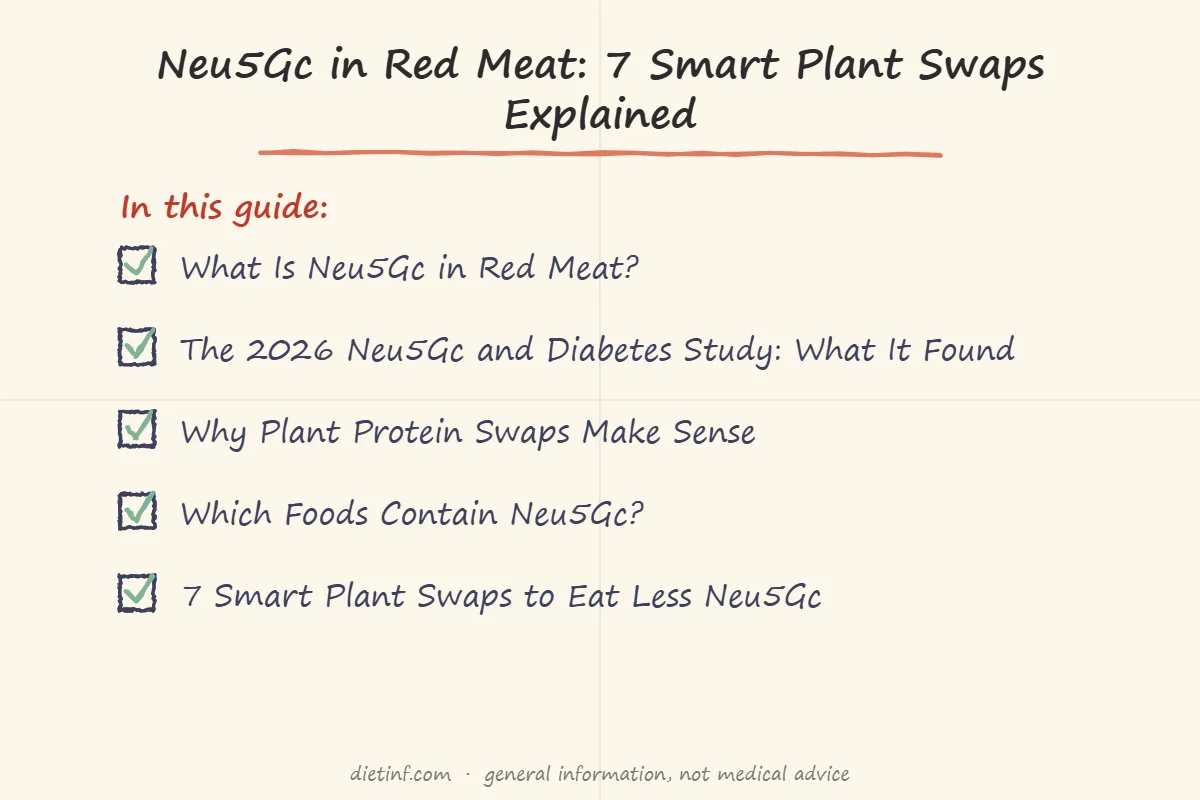
In this guide, you will learn what Neu5Gc is, what the new study really found, which foods contain it, and 7 simple plant swaps you can start this week.
Table of Contents
What Is Neu5Gc in Red Meat?
Neu5Gc (short for N-glycolylneuraminic acid) is a type of sugar molecule. It sits on the outside of cells in most mammals, like cows, sheep, goats and pigs. Think of it as a tiny name tag on the surface of their cells.
Humans are different. Millions of years ago, our ancestors lost a working copy of the gene (called CMAH) that makes Neu5Gc. Our cells make a close cousin called Neu5Ac instead.
Why your body treats Neu5Gc as foreign
Here is the twist. Even though we cannot make Neu5Gc, we can absorb it from food. When you eat beef, lamb or some cheeses, small amounts of Neu5Gc can end up in your own tissues.
Your immune system sees this sugar as “not from here.” Most people develop antibodies against Neu5Gc early in life. A 2020 study of French adults published in BMC Medicine found that people who ate more Neu5Gc tended to have higher levels of these anti-Neu5Gc antibodies. Men, who ate more red meat on average, had higher levels than women.
What is xenosialitis?
Scientists use the word xenosialitis to describe the low-grade inflammation that may happen when dietary Neu5Gc meets these antibodies. In mouse studies, this process was linked to more inflammation and more tumors.
It is important to be clear: this is still a theory in humans. The BMC Medicine authors themselves said current evidence does not show Neu5Gc directly causes disease. They describe it as a factor that might help push disease along.
Is it cooked away?
No. According to a summary from the American Institute for Cancer Research (AICR), cooking did not change Neu5Gc levels in the foods tested. So well-done steak is not lower in Neu5Gc than rare steak.
The 2026 Neu5Gc and Diabetes Study: What It Found
The new research comes from Dr. Leopold Fezeu and colleagues at Université Sorbonne Paris Nord. It was presented at the European Association for the Study of Diabetes (EASD) annual meeting and summarized by ScienceDaily in October 2026.
How the study worked
- The team used data from NutriNet-Santé, a large French study that tracks people’s diets over time.
- It included 89,953 adults (average age 42, about 79% women) with no diabetes or cancer at the start.
- Each person filled in three detailed 24-hour food records.
- Researchers estimated how much meat-derived Neu5Gc each person ate, then followed them for a median of about 7 years.
- During that time, 966 people developed type 2 diabetes.
The key results
- People in the top fifth for meat-derived Neu5Gc had about a 63% higher risk of type 2 diabetes than those in the bottom fifth.
- The second-highest group had about a 41% higher risk.
- Neu5Gc from dairy showed no link to diabetes.
- Body weight explained only a small part of the link (roughly 13%).
For context, people in the top group ate a median of about 97 g of red meat a day (men) and 73 g (women). That is roughly one small steak or burger patty daily.
What the study did NOT show
This is the part many headlines skipped. When researchers adjusted for total red meat intake, the Neu5Gc link was no longer statistically significant. So we cannot tell whether Neu5Gc itself is the problem, or something else in red meat (like heme iron, saturated fat or how it is cooked).
Other limits:
- It is observational, so it shows a link, not cause and effect.
- Neu5Gc intake was estimated from food records, not measured in blood.
- The findings were presented at a conference and are described as preliminary.
The researchers suggest the next step is testing whether swapping beef and lamb for poultry or plant protein lowers risk. That is a hypothesis, not a proven result. But the case for swapping some red meat for plants does not rest on Neu5Gc alone.
Why Plant Protein Swaps Make Sense
Even if the Neu5Gc story turns out to be only part of the picture, the bigger evidence on red meat and diabetes is strong and consistent.
Harvard: swapping one serving helps
A 2023 analysis from the Harvard T.H. Chan School of Public Health followed 216,695 US adults for up to 36 years. Key findings:
- The highest red meat eaters had about a 62% higher risk of type 2 diabetes than the lowest.
- Each extra daily serving of processed red meat (bacon, hot dogs, deli meat) was linked to about a 46% higher risk.
- Each extra daily serving of unprocessed red meat was linked to about a 24% higher risk.
- Swapping one daily serving of red meat for nuts or legumes was linked to about a 30% lower risk.
Nearly 2 million people across 20 countries
A 2024 study in The Lancet Diabetes & Endocrinology, led by the University of Cambridge’s InterConnect project, pooled data from about 1.97 million adults in 31 cohorts. It found:
- 50 g a day of processed meat (about 2 slices of ham) was linked to about 15% higher diabetes risk over 10 years.
- 100 g a day of unprocessed red meat (a small steak) was linked to about 10% higher risk.
- The poultry link was weak and uncertain.
Where Neu5Gc fits
Neu5Gc may be one of several possible reasons red meat is linked to diabetes, alongside heme iron, saturated fat, sodium and preservatives in processed meat. The good news is that plant swaps cut all of these at once. Beans, lentils, tofu and nuts contain zero Neu5Gc, and they add fiber, which supports steady blood sugar.
If you want to dive deeper into blood sugar and eating patterns, read our guide on the Mediterranean diet and diabetes.
Which Foods Contain Neu5Gc?
Neu5Gc is found almost only in foods from mammals. Plants, poultry and most seafood contain none.
How much Neu5Gc in red meat vs. other foods?
The numbers below are approximate. They come from food testing reported in the BMC Medicine NutriNet-Santé paper and the AICR summary of a 62-food analysis. Levels vary between products.
| Food group | Approx. Neu5Gc level | Notes |
|---|---|---|
| Sheep and goat dairy (some cheeses) | High (about 420 nmol/g on average) | Some cheeses rival red meat |
| Beef | High (about 160 nmol/g) | Highest of the meats tested |
| Red and processed meat overall (beef, lamb, pork, ham) | Moderate to high (about 120 nmol/g on average) | Main source in most diets |
| Cow’s milk dairy | Low (about 20 nmol/g) | Dairy Neu5Gc showed no diabetes link in the 2026 study |
| Fish and seafood | None to very low | Varies by type |
| Chicken and turkey | None | Birds do not make Neu5Gc |
| Beans, lentils, tofu, nuts, grains | None | Plants do not make Neu5Gc |
| Fruits and vegetables | None | Plants do not make Neu5Gc |
Takeaway: If you want to eat less Neu5Gc, the simplest move is to eat less beef, lamb and processed red meat. Every plant protein on your plate is naturally Neu5Gc-free.
7 Smart Plant Swaps to Eat Less Neu5Gc
You do not need to go fully vegan. Start by replacing a few red meat meals each week. These swaps keep protein high and flavor big.
- Beef mince → lentil-walnut mince. Cooked brown lentils plus chopped walnuts give a meaty texture in tacos, chili and bolognese. The Harvard data showed the biggest benefit from swaps to nuts and legumes.
- Burger patty → black bean or chickpea burger. Mash beans with oats, onion and spices, then pan-fry. Add a slice of avocado for healthy fat.
- Steak strips → tofu or tempeh strips. Press firm tofu, slice, marinate in soy sauce, garlic and lime, then bake or air-fry. Tempeh works well in stir-fries.
- Bacon and ham → smoky beans or tempeh “bacon.” Processed meat had the strongest diabetes link in studies. Smoked paprika and a splash of maple make a great savory topping.
- Lamb stew → chickpea and vegetable stew. Keep the cumin, cinnamon and tomato, and swap the meat for chickpeas and butternut squash.
- Sheep or goat cheese → cow’s-milk or plant-based cheese. Since sheep and goat dairy can be high in Neu5Gc, try cow’s-milk feta-style cheese or a cashew spread. Our high-protein vegan cottage cheese guide has easy options.
- Meat-heavy lunch → bean-and-grain bowl. Edamame, quinoa, roasted vegetables and a tahini dressing make a filling, Neu5Gc-free lunch.
Want more protein ideas? Read our full guide to plant-based protein maxxing.
Easy meal ideas and approximate protein
Protein amounts below are approximate and depend on brand and portion.
| Meal | Red meat version | Plant swap | Approx. protein (swap) | Neu5Gc |
|---|---|---|---|---|
| Breakfast | Bacon and eggs | Tofu scramble with black beans | About 20 g | None |
| Lunch | Roast beef sandwich | Hummus, falafel and salad wrap | About 15 g | None |
| Lunch | Beef burrito bowl | Lentil and quinoa bowl | About 20 g | None |
| Dinner | Beef bolognese | Lentil-walnut bolognese | About 22 g | None |
| Dinner | Lamb curry | Chickpea and spinach curry | About 16 g | None |
| Dinner | Steak stir-fry | Tempeh and edamame stir-fry | About 25 g | None |
| Snack | Beef jerky | Roasted chickpeas or edamame | About 8–12 g | None |
For reference, 3 oz (85 g) of cooked beef has roughly 22–25 g of protein, so these meals stay in a similar range.
If you prefer a structured approach, our Mediterranean diet for vegetarians plan builds meals around beans, lentils, nuts and olive oil.
Common Mistakes to Avoid
- Panicking over one study. The 2026 Neu5Gc findings are preliminary. Treat them as one more reason to eat a bit less red meat, not a reason to fear a single steak.
- Swapping beef for ultra-processed meat substitutes only. Some plant burgers are fine now and then, but many are high in sodium. Whole beans, lentils, tofu and nuts are the swaps with the strongest research behind them.
- Forgetting protein. Replacing a steak with plain pasta drops your protein. Pair grains with legumes, tofu, tempeh or edamame at every meal.
- Ignoring processed meat. Bacon, sausages and deli meats had the strongest diabetes links in large studies. Cut these first.
- Thinking cooking removes Neu5Gc. It does not. Cooking method changes other things, like charring, but not the Neu5Gc content.
- Buying “Neu5Gc detox” supplements. There is no proven supplement that removes Neu5Gc or its antibodies. Food choices are what matter.
- Skipping B12 and iron planning. If you cut red meat a lot, eat iron-rich plants (lentils, tofu, spinach) with vitamin C foods, and talk to your doctor about vitamin B12, especially if you go fully vegan.
If you take GLP-1 medicines and want a plant-forward plan that keeps protein high, see our vegetarian meal plan on GLP-1.
FAQ: Neu5Gc in Red Meat
What is Neu5Gc in red meat?
Neu5Gc is a sugar molecule found on the cells of most mammals, including cows, sheep and pigs. Humans cannot make it, but we absorb it from red meat and some dairy. Our immune system may treat it as foreign, which could trigger low-grade inflammation.
Does Neu5Gc cause type 2 diabetes?
Not proven. A 2026 French study linked high meat-derived Neu5Gc intake to about a 63% higher diabetes risk, but the link faded after adjusting for total red meat. It shows an association, not cause and effect.
Which foods have no Neu5Gc?
All plant foods (beans, lentils, tofu, nuts, grains, fruits and vegetables) contain no Neu5Gc. Chicken and turkey contain none, and most seafood has little or none.
Does cooking meat remove Neu5Gc?
No. Testing summarized by the American Institute for Cancer Research found cooking did not change Neu5Gc levels in food.
How much red meat is okay to eat?
AICR suggests limiting cooked red meat to about 18 ounces (around 510 g) per week and eating little or no processed meat. Harvard research found swapping just one daily serving for nuts or legumes was linked to about a 30% lower diabetes risk.
Conclusion: Small Swaps, Big Picture
Neu5Gc in red meat is a fascinating new clue in the long story of red meat and health. Humans cannot make this sugar, our immune system may react to it, and a large 2026 study linked higher intake to more type 2 diabetes. But the science is still early, and Neu5Gc is likely only one piece of the puzzle.
What we do know is solid: decades of research show that eating less red and processed meat, and more beans, lentils, nuts and tofu, is linked to lower diabetes risk. Those same swaps also happen to be Neu5Gc-free.
Your next step: pick two of the 7 swaps above and try them this week. Maybe lentil bolognese on Monday and a tofu stir-fry on Thursday. Then explore more plant-based guides on Dietinfo, and share this article with a friend who loves a good burger.
Medical disclaimer: This article is for information only and is not medical advice. It does not replace advice from your doctor or a registered dietitian. If you have diabetes, prediabetes or another health condition, talk to a qualified health professional before making big changes to your diet.
Sources
- ScienceDaily (Oct 2026): Scientists link a strange sugar in red meat to a 63% higher diabetes risk
- Bashir S, Fezeu LK, et al. (2020): Neu5Gc carbohydrate and serum antibodies: French NutriNet-Santé study, BMC Medicine 18:262
- American Institute for Cancer Research: Study gives new insights on red meat, a sugar and cancer
- Harvard T.H. Chan School of Public Health (2023): Red meat consumption associated with increased type 2 diabetes risk
- University of Cambridge, InterConnect (2024): Red and processed meat and type 2 diabetes risk