Eating peanuts a day for brain health has become one of the most talked-about food ideas of the autumn, and for once the buzz comes from a real clinical trial. A study reported on November 1, 2026 found that a daily portion of roasted peanuts changed how memory-related brain regions responded to insulin in healthy older adults.
That sounds exciting. It is also easy to misread.
Headlines can make it seem like a snack will protect you from dementia. The trials do not show that. They were small, they looked at healthy people, and they were funded by a peanut industry foundation.
This guide explains what the research really found, in plain English. You will learn how much the volunteers ate, what changed, what did not, and how to try the habit without adding salt, sugar or unwanted weight. You will also find a table of meal ideas and answers to common questions.
If you already follow a brain-friendly pattern such as the MIND diet for vegetarians, peanuts can fit in easily. They are cheap, widely sold and simple to use. The aim here is not to crown a superfood. It is to help you decide whether this small habit makes sense for you.
Table of Contents
What do peanuts a day for brain health actually do?
The short answer: in two reports from one small trial, peanuts a day for brain health were linked to better blood flow, a small memory gain and a better insulin response in parts of the brain. Nobody has shown that they prevent dementia or Alzheimer’s disease.
The idea is simple. The brain uses a lot of energy and depends on a steady blood supply. Insulin is best known for handling blood sugar, but it also acts in the brain, including in areas tied to memory. Researchers suspect that poor brain insulin response may play a part in age-related decline.
So the Maastricht team asked a clear question. If healthy older adults add a fixed amount of peanuts to their normal eating for 16 weeks, do these brain measures change?
Peanuts vs. peanut butter vs. salted snacks
This detail matters. The volunteers ate unsalted, skin-roasted runner peanuts. They did not eat honey-roasted nuts, flavored snack mixes or peanut butter cups. According to PsyPost’s report on the trial, other forms such as peanut butter, and smaller doses, remain untested for these outcomes.
Peanut butter may still be a fine food. We just cannot assume it gives the same result.
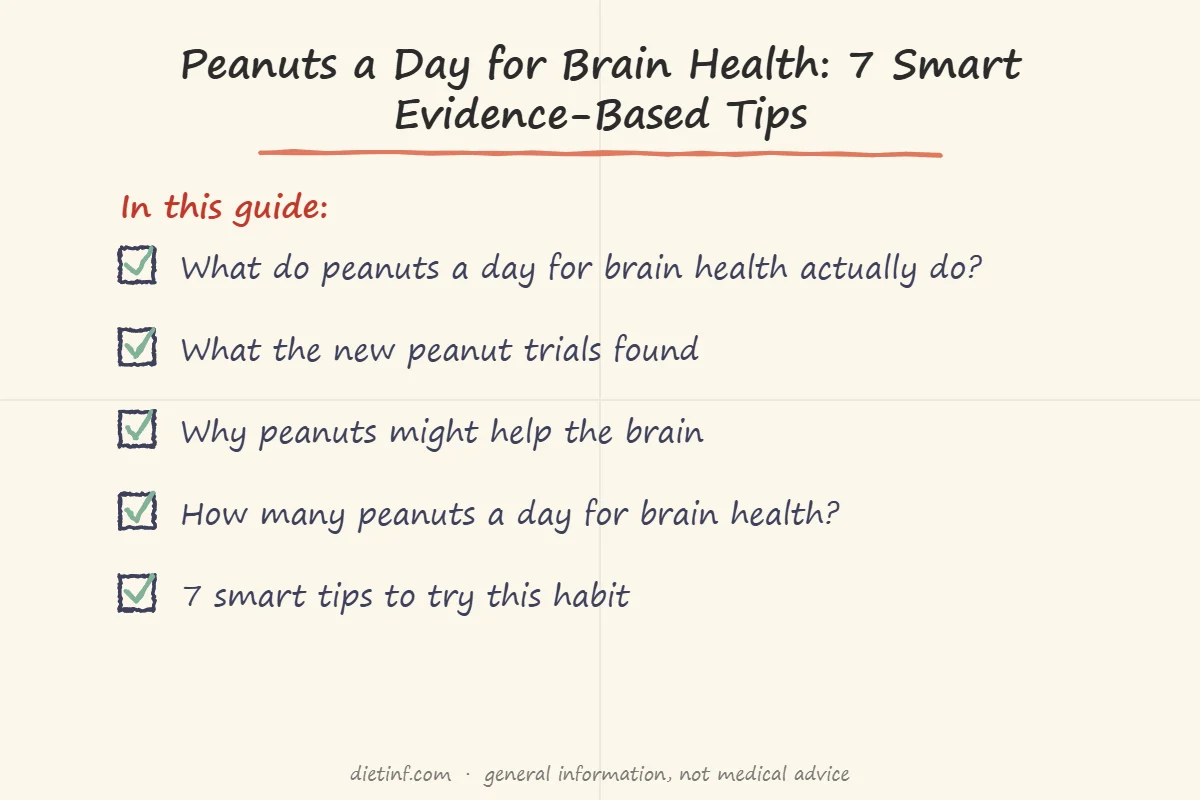
What the new peanut trials found
Two papers have come out of the same group of 31 volunteers aged 60 to 75. Everyone spent 16 weeks eating 60 grams of peanuts a day and 16 weeks without them, in a crossover design. That means each person acted as their own comparison.
| Finding | Peanut phase vs. control | Published in | What it does not tell us |
|---|---|---|---|
| Whole-brain blood flow | Up about 3.6% | Clinical Nutrition, 2025 | Whether this lowers dementia risk |
| Verbal memory (delayed word recognition) | Improved about 5.8% | Clinical Nutrition, 2025 | Whether people notice it in daily life |
| Systolic blood pressure | Down about 5 mmHg | Clinical Nutrition, 2025 | Whether it lasts beyond 16 weeks |
| Executive function and psychomotor speed | No significant change | Clinical Nutrition, 2025 | Why memory changed and these did not |
| Insulin response in memory-related regions | Improved (hippocampus and nearby areas, right side) | Food & Function, 2026 | The size of the effect, which the summary does not give |
The blood flow, memory and blood pressure figures come from the 2025 news release on the Clinical Nutrition paper. The insulin findings come from ScienceDaily’s summary of the 2026 Food & Function paper. Both of those summaries trace back to material from the peanut industry, so treat the framing with care. I read the summaries, not the full papers, so the numbers above are as reported there.
The newest result: brain insulin
In the 2026 report, researchers gave insulin through a nasal spray and used MRI to see how blood flow shifted in different brain regions. After the peanut phase, the response improved in regions on the right side of the brain linked to memory, including the hippocampus and the posterior cingulate gyrus.
That is an interesting lab-style signal. It is a change in a brain measure, not proof of better memory by itself.
How strong is this evidence?
Fair question. Here is an honest scorecard.
- Good points: randomized design, each person compared with themselves, MRI measures, and blinded analysts for the imaging and test data.
- Weak points: only 31 people, all healthy, and participants knew when they were eating peanuts.
- Funding: The Peanut Institute Foundation paid for the research. The authors report that the funder had no role in the design, analysis or writing.
- Still unknown: the long-term effect, and whether results apply to people with memory problems, diabetes or other conditions.
Overall, this is early but promising evidence. It is enough to make peanuts a sensible food to include. It is not enough to call them a treatment.
Longer-term evidence on peanuts and health
Older research gives useful background, though it looks at the heart and lifespan rather than memory. Harvard Health described a large study of more than 200,000 people in the US and China. Regular peanut or nut eaters had death rates around 17% to 21% lower over several years.
That study was observational, so it cannot prove cause and effect. People who eat nuts may differ in other ways. Still, it supports the wider point that peanuts can be part of a healthy diet.
Why peanuts might help the brain
No one knows the exact reason yet. The researchers suspect a mix of nutrients working together rather than one magic compound. Remember that peanuts are technically a legume, which makes them a low-cost plant protein as well.
Here is what about 1 ounce (28 g) of unsalted dry-roasted peanuts provides, based on this nutrition facts listing. All numbers are approximate.
| Nutrient | Approx. amount per 1 oz | Why it is of interest |
|---|---|---|
| Calories | 166 kcal | Energy dense, so portions matter |
| Protein | 6.7 g | Helps meals keep you full |
| Total fat | 14 g (about 2 g saturated) | Mostly unsaturated fat |
| Fiber | 2.3 g | Supports gut health and fullness |
| Niacin | 3.8 mg | A B vitamin used in energy metabolism |
| Vitamin E | 2 mg | An antioxidant nutrient |
| Folate | 41 mcg | A B vitamin needed for normal cell function |
| Magnesium | 50 mg | Involved in nerve and muscle function |
The research team also points to L-arginine, an amino acid the body can use to make nitric oxide, which helps blood vessels relax. This is one possible explanation, not a proven mechanism. Polyphenols in the thin red skin may also play a part.
If you want more plant protein ideas, see our guide to plant-based protein maxxing.
How many peanuts a day for brain health?
The trial dose was 60 grams a day, about 2 ounces or two standard servings. No one has yet tested the smallest amount that works, so there is no proven dose of peanuts a day for brain health.
Sixty grams adds roughly 340 calories. In the trial, body weight stayed generally stable, but that does not mean it would for everyone. If you add this amount on top of your usual food and change nothing else, it could lead to weight gain over time.
How many peanuts a day for brain health should a beginner eat?
For most healthy adults, 1 ounce a day is a sensible place to start. It is about a small handful or a quarter cup.
Major health sources offer slightly different guidance. Harvard Health suggests about 1 to 2 ounces of nuts and seeds a day. Mayo Clinic suggests about 4 to 6 servings of unsalted nuts a week, with a serving being about 1 ounce. So 1 ounce on most days fits within both, while 2 ounces daily sits at the top of Harvard’s range.
Think of the trial dose as an upper level to work up to, not a target you must hit.
7 smart tips to try this habit
These steps are practical suggestions based on the trial design and general nutrition advice. They are not a tested program.
- Buy unsalted and dry-roasted. Mayo Clinic advises choosing unsalted nuts, and raw or dry-roasted over oil-roasted, since added salt or sugar may cancel out some of the benefits.
- Keep the skins on. The trial used skin-roasted peanuts, and the skins contain plant compounds that are being studied.
- Weigh your portion for one week. A kitchen scale teaches your eye what 28 g looks like. After that, you can pour a measured amount into a small bowl.
- Swap, do not simply add. Replace a cookie, chips or a sweet snack with peanuts. That way, you add nutrients without piling on extra calories.
- Eat them when it suits you. Trial volunteers could eat their portion all at once, split it up or add it to meals, in the morning or afternoon. Choose the routine you will actually keep.
- Store them well. Keep peanuts in a cool, dry place and throw away any that look moldy, shriveled or discolored, or that taste off. Nuts can turn rancid, and moldy peanuts are a known aflatoxin concern. The FDA uses a 25 parts per billion action level for aflatoxins in peanut products.
- Make it part of a bigger pattern. Sleep, activity, blood pressure control and an overall healthy diet matter far more than any one food. Our Mediterranean diet for beginners guide is a good next step.
Peanuts can also support a heart-friendly plate. Since the trial saw a drop in systolic blood pressure, it is worth reading about other foods that lower blood pressure too. Just remember that salted peanuts work against that goal.
Easy peanut meal ideas
You do not need to eat plain peanuts from a bag every day. Try these simple ways to fit a portion into your week. Calorie values are approximate and cover the peanuts only.
| Meal | Idea | Peanut portion | Approx. peanut calories |
|---|---|---|---|
| Breakfast | Oatmeal with banana, cinnamon and chopped peanuts | 1 oz (28 g) | 166 |
| Breakfast | Greek or soy yogurt with berries and crushed peanuts | 1/2 oz (14 g) | 83 |
| Lunch | Cabbage, carrot and edamame salad with lime and peanuts | 1 oz (28 g) | 166 |
| Lunch | Brown rice bowl with tofu, broccoli and peanuts | 1 oz (28 g) | 166 |
| Snack | Plain skin-on peanuts with an apple | 1 oz (28 g) | 166 |
| Dinner | Vegetable stir-fry with chickpeas and peanuts | 1/2 oz (14 g) | 83 |
| Dinner | Lentil and sweet potato stew topped with peanuts | 1/2 oz (14 g) | 83 |
A note on crushing and cooking: the trial used whole peanuts that were not further heated or crushed. Chopping a few over a salad is unlikely to turn a healthy food into an unhealthy one, but we cannot say the same results apply.
For more snack ideas that fit a Mediterranean-style plate, see our list of the best Mediterranean diet snacks for weight loss.
A 4-week starter plan for peanuts a day for brain health
A slow start makes the habit easier to keep. It also gives your digestion time to adjust to the extra fiber and fat. This plan is a practical suggestion, not a tested protocol.
- Week 1: learn the portion. Eat 1/2 ounce a day, about half of a small handful. Weigh it so you know what it looks like.
- Week 2: make a swap. Move up to 1 ounce a day, and use it to replace one snack you would like to cut back on.
- Week 3: try it in meals. Add peanuts to oatmeal, a salad or a stir-fry two or three times. This keeps the habit from getting boring.
- Week 4: review. Check your weight, your energy and how your clothes fit. If all is well, carry on with 1 ounce, or talk to a dietitian if you want to go higher.
The goal of peanuts a day for brain health is a routine you can keep for months. The trial ran for 16 weeks, so a few days of snacking should not be expected to change much.
What real success looks like
You are unlikely to feel any sharper after a week, and that is normal. Changes in the trial were measured with MRI scans and memory tests, not by how people felt.
So judge peanuts a day for brain health by things you can actually track. Did you cut back on a less healthy snack? Did you stick to your portion? Is your blood pressure on target at your next check-up? These are useful wins, whatever future studies show.
It also helps to look at the whole week. A person who eats vegetables, beans, whole grains and fish or other healthy proteins, while staying active and sleeping well, is giving the brain broad support. Peanuts a day for brain health can be one small part of that, alongside a balanced diet.
Common mistakes to avoid
A healthy habit can go wrong in small ways. Watch out for these.
- Expecting a cure. Peanuts a day for brain health is a food habit, not a treatment. If you or a loved one has memory changes, see a doctor rather than relying on diet.
- Choosing the wrong product. Honey-roasted, candy-coated or heavily salted peanuts are different foods from the ones tested. Check the label for just one ingredient: peanuts.
- Eating straight from a large bag. Peanuts are easy to overeat. Three handfuls can pass 450 calories before you notice.
- Ignoring the rest of your plate. Eating more than one or two handfuls a day can crowd out other healthy foods, as Harvard Health notes.
- Trusting one headline. A single small trial should nudge your choices, not overturn them. Wait for larger studies before treating any claim as settled.
- Buying a peanut extract instead. Nothing in these trials supports capsules, powders or brain supplements. The volunteers ate actual food.
Who should be careful
Peanuts are not right for everyone.
- People with peanut allergy must avoid them completely. Food allergy reactions range from mild to severe, as the NIAID food allergy page explains.
- Parents of babies should ask their pediatrician about peanut introduction. NIAID notes that early exposure helped prevent allergy in high-risk infants, but this needs medical guidance. Whole peanuts are also a choking risk for young children.
- People on a calorie, sodium or potassium plan, including those with kidney disease or heart failure, should check with their doctor or dietitian.
- People with swallowing problems should avoid whole nuts unless their care team says otherwise.
FAQ
Can peanuts improve memory?
Possibly, by a small amount. In one 16-week trial of 31 healthy older adults, verbal memory improved about 5.8% during the peanut phase. Other thinking skills did not change significantly, and larger studies are needed.
How many peanuts should I eat a day for brain health?
No ideal amount is known. The trial used 60 grams, about 2 ounces, a day. For most healthy adults, starting with 1 ounce (a small handful) is a practical choice that fits general nut advice.
Is peanut butter just as good?
We do not know. The trial tested whole, unsalted, skin-roasted peanuts, and peanut butter has not been tested for these results. If you choose it, look for a product made from peanuts alone, with little or no added salt or sugar.
Will eating peanuts every day make me gain weight?
It can if the calories are simply added on top of your usual diet. Weight stayed generally stable in the trial, but swapping peanuts for another snack is the safer plan.
Do peanuts prevent Alzheimer’s disease?
There is no evidence that they do. The trials measured blood flow, brain insulin response and short-term memory in healthy people, not who developed Alzheimer’s disease.
Conclusion
The evidence for peanuts a day for brain health is early, small and industry funded, but it is also real and interesting. Healthy older adults who ate 60 grams a day for 16 weeks showed better brain blood flow, a modest memory gain and a better insulin response in memory-related regions.
So here is a balanced takeaway. If you are not allergic, a daily handful of unsalted, skin-on peanuts is a cheap and tasty swap for a less healthy snack. Just do not expect it to do the work of good sleep, regular movement and a balanced diet.
Ready to try it? Replace one snack with a measured ounce of peanuts this week, and see how it fits your routine. Then explore our guide to the MIND diet for vegetarians for a fuller brain-friendly eating plan. Which peanut meal will you try first? Tell us in the comments.
Medical disclaimer: This article is for information only and is not medical advice. Talk to your doctor or a registered dietitian before making major diet changes, especially if you have an allergy, a medical condition or take medication.
Sources
- ScienceDaily: Scientists discover a surprising brain benefit of eating peanuts every day (summary of Kerkhof et al., Food & Function, 2026; based on a release from the funder’s affiliate)
- EurekAlert: release on the Clinical Nutrition 2025 peanut trial (issued by The Peanut Institute)
- PsyPost: report on the 16-week peanut trial
- Harvard Health: Peanuts linked to same heart, longevity benefits as more pricey nuts
- Harvard Health: Quick-start guide to nuts and seeds
- Mayo Clinic: Nuts and your heart
- NIAID (NIH): Causes and prevention of food allergy
- FDA: CPG Sec 570.375, Aflatoxins in peanuts and peanut products
- University Hospitals: Nutrition facts for dry-roasted peanuts without salt, 1 oz