If you have searched for foods that increase humanin naturally, you are probably reacting to the same headline many of us saw this week: “Mediterranean diet may boost tiny proteins that protect the heart and brain.” The story is spreading fast across news sites and social feeds, and it sounds almost too good to be true.
So what is really going on? A team from the University of Southern California (USC) and Sapienza University of Rome found that older adults who ate a more Mediterranean-style diet had higher blood levels of two tiny proteins made by mitochondria: humanin and SHMOOSE. These proteins are being studied for their links to heart health, brain health and aging.
This guide explains the science in plain English. You will learn what humanin is, which foods were actually linked to higher levels, how strong the evidence is (spoiler: early, not final), and how to build easy meals around these foods. We will also cover common mistakes, so you do not fall for the hype.
One promise up front: no miracle claims and no pills to buy. Just real food, real studies, and honest limits.
Table of Contents
What is humanin? (The tiny protein behind the headlines)
Humanin is a very small peptide (about 21 to 24 amino acids long) that is coded by DNA inside your mitochondria, the parts of your cells that make energy. It was first described in the early 2000s, and scientists now know of about nine of these “mitochondrial-derived peptides.”
A 2023 systematic review of humanin and aging explains that, in lab and animal research, humanin seems to protect cells. It may help cells resist stress, lower oxidative damage and support the cell’s clean-up system (autophagy).
In people, the picture is mostly observational. Lower humanin levels have been reported in people with type 2 diabetes, coronary heart disease and Alzheimer’s disease. Children of people who lived past 100 tend to have higher levels.
What is SHMOOSE?
SHMOOSE is a newer microprotein found by the same USC research group. Its odd name stands for “Small Human Mitochondrial ORF Over SErine tRNA.” A common gene variant of SHMOOSE has been linked to higher Alzheimer’s risk, while the normal version may help protect brain cells.
Why this matters for your plate
Researchers think these microproteins may act like messengers between what we eat and how our cells age. As lead author Roberto Vicinanza put it, they “may act as molecular messengers that translate what we eat into how our cells function and age” (USC Leonard Davis School).
That is an exciting idea. But it is still an idea being tested, not a proven fact.
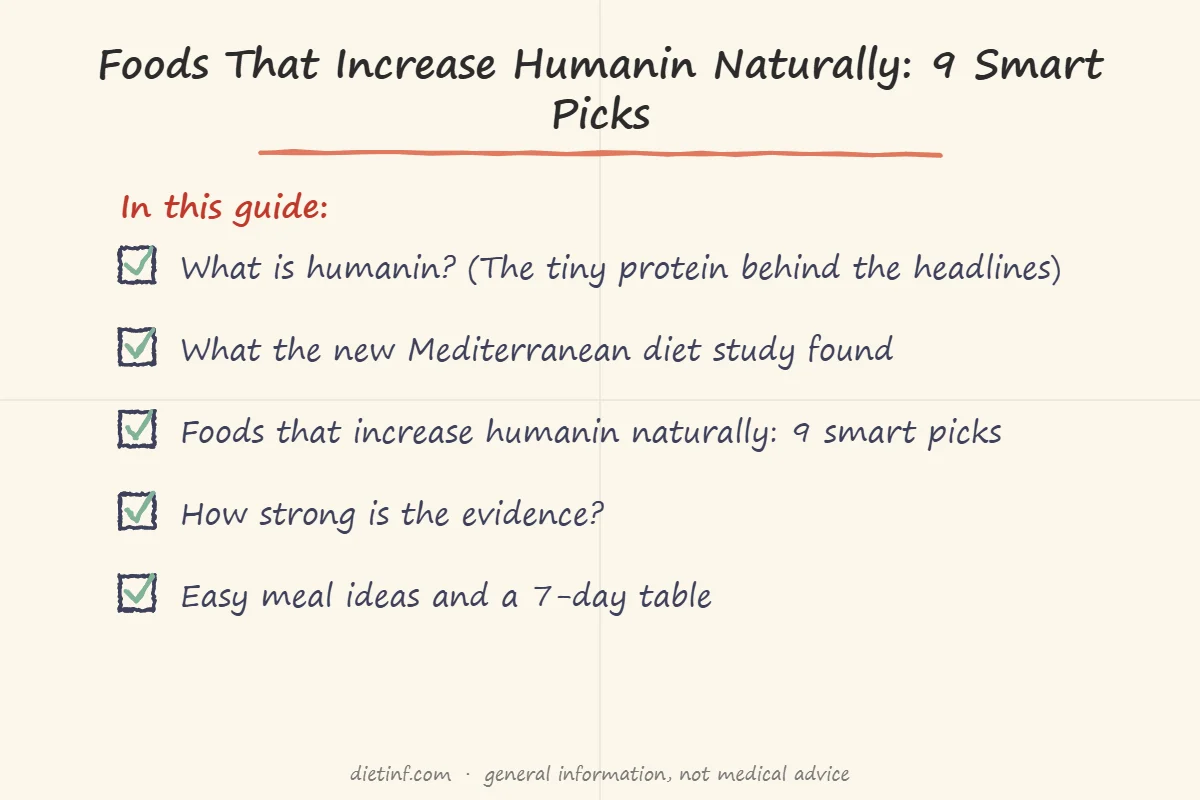
What the new Mediterranean diet study found
The study behind the buzz was published in Frontiers in Nutrition and was featured again by ScienceDaily on October 24, 2026. Here are the key points, in simple terms:
- Who: 49 older adults in Rome, Italy (average age about 78), all with atrial fibrillation, and most with high blood pressure.
- How diet was measured: a short 9-point Mediterranean diet questionnaire. About 4 in 10 people scored “high adherence” (7 to 9 points).
- Main result: people who followed the Mediterranean diet more closely had higher humanin and SHMOOSE levels and lower markers of oxidative stress.
- Food links to humanin: using olive oil every day, eating fish 3 or more times a week, and eating legumes 2 or more times a week.
- Food links to SHMOOSE: using olive oil every day and eating less than one serving of white bread a day.
- Heart angle: higher humanin went along with lower activity of Nox2, an enzyme that produces harmful reactive oxygen molecules.
The Mediterranean diet humanin link in one sentence
In a small group of older Italian adults, a more Mediterranean way of eating, especially olive oil, fish, legumes and less white bread, went hand in hand with higher levels of two protective-looking mitochondrial proteins.
If you want the bigger picture on why this eating pattern is so well studied, read our guide on how the Mediterranean diet improves heart health.
Foods that increase humanin naturally: 9 smart picks
Before we list the foods that increase humanin naturally, one honest note. Only four food habits were directly linked to humanin or SHMOOSE in the study: olive oil, fish, legumes and eating less white bread. Picks 5 to 9 are core Mediterranean foods that make up the rest of the pattern. They have strong evidence for heart health in general, but no direct humanin data yet.
1. Extra virgin olive oil (the strongest link)
Daily olive oil (at least 1 tablespoon) was the only habit tied to higher levels of both humanin and SHMOOSE. Use it as your main fat: drizzle it on salads, roast vegetables with it, and swap it for butter on bread.
2. Fatty fish, about 3 times a week
Eating fish 3 or more times a week was linked to higher humanin. Good choices are salmon, sardines, mackerel and trout. Mayo Clinic’s Mediterranean diet guide suggests fish 2 to 3 times a week, about 3 to 5 ounces per serving, and choosing low-mercury fish.
3. Legumes: beans, lentils and chickpeas
Two or more servings of legumes a week went along with higher humanin. This is great news for plant-based eaters. Lentil soup, chickpea salads, hummus and bean chili all count. A serving is roughly half a cup cooked (approximate).
4. Whole grains instead of white bread
People who ate less than one serving of white bread a day had higher SHMOOSE. Swap white bread for whole grain bread, oats, barley, bulgur or brown rice. You still get the comfort of grains, with more fiber.
5. Leafy greens and colorful vegetables
Vegetables are the base of the Mediterranean plate. Mayo Clinic suggests about 4 or more servings a day. Spinach, kale, tomatoes, peppers and eggplant pair perfectly with olive oil.
6. Nuts and seeds
A small handful (about a quarter cup) of walnuts, almonds or pistachios most days fits the pattern well. Nuts add healthy fats and plant protein.
7. Fresh fruit
Two to three servings of whole fruit a day, such as berries, oranges, figs or apples, can replace sugary desserts.
8. Herbs and spices
Oregano, garlic, rosemary, basil and cumin add flavor so you need less salt. They make plain beans and greens far more exciting.
9. Plain yogurt and small amounts of cheese
Moderate dairy, like plain Greek yogurt and a little feta, is part of the traditional pattern. Keep portions modest.
For a full shopping list built around these foods, see our Mediterranean diet grocery list and our list of Mediterranean diet approved foods.
Quick-view table: foods that increase humanin naturally and the evidence
| Food | How much (approximate) | Link to humanin or SHMOOSE in the 2026 study | Easy way to eat it |
|---|---|---|---|
| Extra virgin olive oil | 1+ tablespoon a day | Higher humanin and SHMOOSE | Salad dressing, roasting, dipping bread |
| Fatty fish | 3 servings a week | Higher humanin | Baked salmon, sardines on toast |
| Legumes | 2+ servings a week | Higher humanin | Lentil soup, hummus, bean chili |
| Less white bread | Under 1 serving a day | Higher SHMOOSE | Whole grain bread, oats, barley |
| Vegetables | 4+ servings a day | Not measured directly | Greek salad, roasted veg tray |
| Nuts and seeds | About 1/4 cup most days | Not measured directly | Walnuts on oatmeal |
| Fruit | 2 to 3 servings a day | Not measured directly | Berries with yogurt |
| Herbs and spices | Daily | Not measured directly | Garlic and oregano on beans |
| Yogurt and cheese | Moderate | Not measured directly | Greek yogurt bowl, a little feta |
How strong is the evidence?
The honest answer: the evidence on foods that increase humanin naturally is promising but early. The authors themselves list clear limits:
- Small sample: only 49 people.
- Narrow group: older adults with atrial fibrillation, so results may not apply to younger or healthy people.
- Observational design: it shows a link, not cause and effect. We do not yet know if eating these foods actually raises humanin.
- Simple diet tool: a 9-item questionnaire cannot capture everything people eat.
- Missing factors: exercise and other lifestyle habits were not fully accounted for.
The researchers say their next step is to test whether switching to a Mediterranean diet raises these proteins, and whether that leads to better health.
The good news is that you do not need to wait. The Mediterranean diet already has decades of evidence for heart health from large trials such as PREDIMED. Eating more of these foods is a low-risk, high-reward choice, whatever the final humanin verdict turns out to be.
A related story: fish oil pills vs fish on your plate
In the same week, a two-year USC trial of 365 older adults found that high-dose DHA fish oil pills (2,000 mg a day) did not improve memory test scores or slow brain shrinkage. The researchers suggest omega-3s from whole foods within a balanced diet may work differently from isolated pills. The lesson is the same: focus on food patterns, not single supplements.
Easy meal ideas and a 7-day table
Here is a simple week that brings the foods that increase humanin naturally onto your plate. It hits daily olive oil, about 3 fish meals and 3+ legume meals, and almost no white bread. Vegetarian swaps are in brackets.
| Day | Breakfast | Lunch | Dinner |
|---|---|---|---|
| Monday | Oats with walnuts and berries | Lentil and vegetable soup, whole grain bread with olive oil | Baked salmon, roasted vegetables, barley (tofu instead of salmon) |
| Tuesday | Greek yogurt, figs, pistachios | Chickpea, cucumber and tomato salad with olive oil dressing | Whole wheat pasta with spinach, garlic and white beans |
| Wednesday | Whole grain toast, avocado, tomato | Leftover pasta and a green salad | Sardine and tomato skillet with brown rice (chickpea version) |
| Thursday | Overnight oats with apple and cinnamon | Hummus wrap in a whole wheat tortilla with roasted peppers | Black bean and vegetable chili |
| Friday | Yogurt bowl with oats and berries | Leftover chili with a side salad | Grilled trout, herby potatoes, green beans (lentil patties) |
| Saturday | Veggie omelet cooked in olive oil, whole grain toast | Greek salad with feta and a handful of almonds | Shakshuka with chickpeas and spinach |
| Sunday | Buckwheat pancakes with fruit | Farro bowl with roasted vegetables and tahini | Lentil and mushroom stew with a big salad |
Simple swaps that add up
- Swap butter for extra virgin olive oil.
- Swap white sandwich bread for whole grain or sourdough rye.
- Swap one meat dinner for a bean or lentil dinner.
- Swap chips for a small handful of nuts.
- Swap a sweet dessert for fruit with yogurt.
New to this way of eating? Our Mediterranean Diet for Beginners guide walks you through the first two weeks. If you do not eat fish, our Mediterranean diet for vegetarians guide shows how to build balanced plant-based plates, and the MIND diet for vegetarians focuses on brain-friendly foods.
Lifestyle habits that may support humanin
Eating foods that increase humanin naturally is only part of the story. According to the humanin review, humanin made in muscle rises in response to exercise. That does not prove a workout will change your blood levels, but regular movement is good for the heart and brain anyway.
- Move most days: brisk walking, cycling or swimming.
- Add strength training about twice a week.
- Sleep 7 to 9 hours.
- Limit alcohol. Mayo Clinic advises not to start drinking for health reasons.
- Do not smoke.
Common mistakes to avoid
- Treating one study as proof. A 49-person observational study is a starting point. Be wary of anyone who says foods that increase humanin naturally “guarantee” longer life.
- Buying “humanin boosters.” Humanin supplements, peptide injections or “mitochondria pills” sold online have no proven benefit for healthy people and may be unsafe. Food is the safe route.
- Drowning food in oil. Olive oil is healthy, but it is still about 120 calories per tablespoon (approximate). Use it instead of other fats, not on top of them.
- Fried fish and fish-and-chips. Mayo Clinic advises avoiding deep-fried fish. Bake, grill or poach it instead.
- Adding legumes too fast. Jumping from zero to beans at every meal can cause gas and bloating. Add them slowly and drink enough water.
- Forgetting the whole pattern. The study measured an overall diet score. Adding olive oil to a diet of fast food and soda is not the same as eating Mediterranean.
- Swapping white bread for “whole wheat” ultra-processed snacks. Check labels. Choose real whole grains with short ingredient lists.
FAQ
What foods increase humanin naturally?
In a 2026 study of older adults, daily olive oil, fish about 3 times a week and legumes 2 or more times a week were linked to higher humanin. Eating less white bread was linked to higher SHMOOSE, a related microprotein. The study shows links, not proof of cause.
Does the Mediterranean diet raise humanin levels?
People who followed the Mediterranean diet more closely had higher humanin and SHMOOSE levels. But the study was small and observational. Researchers still need trials to show whether starting the diet actually raises these proteins.
Can vegetarians or vegans get the same benefits?
Olive oil, legumes and whole grains, three of the four habits linked in the study, are fully plant-based. Fish was the only animal food linked to humanin. Vegetarians can lean on legumes, nuts, seeds and olive oil, and talk to a dietitian about omega-3 needs.
Should I take humanin supplements?
No. There is no good evidence that humanin supplements or peptide injections help healthy people, and their safety is not established. Focus on food, movement and sleep, and ask your doctor before trying any supplement.
How long does it take to see benefits from the Mediterranean diet?
No one knows yet how fast humanin levels might change. For heart health, Mayo Clinic notes that benefits depend on following the diet over the long term. Think of it as a lifelong habit, not a quick fix.
Conclusion
The viral “tiny proteins” headline is real science, but it is early science. In a small group of older adults, olive oil, fish, legumes and fewer white-bread servings went along with higher levels of humanin and SHMOOSE, two mitochondrial proteins linked to heart and brain health.
The best part is that the foods that increase humanin naturally, at least according to this first study, are the same everyday foods that already have strong evidence for heart health. You do not need special powders or pills. You need a bottle of good olive oil, a bag of lentils, some fish (or more beans) and whole grains.
Your next step: pick one day from the 7-day table above and cook it this week. Then explore our Mediterranean Diet for Beginners guide to make it a habit. Have a favorite lentil or olive oil recipe? Share it in the comments below.
Medical disclaimer
This article is for information only and is not medical advice. Always talk to your doctor or a registered dietitian before changing your diet, especially if you have a health condition, take medication (for example, blood thinners) or are pregnant.
Sources
- Vicinanza R, et al. Mediterranean diet adherence and mitochondrial microproteins humanin and SHMOOSE. Frontiers in Nutrition, 2026
- ScienceDaily: Mediterranean diet may boost tiny proteins that protect the heart and brain (Oct 24, 2026)
- USC Leonard Davis School of Gerontology: Mediterranean diet and mitochondria health
- Coradduzza D, et al. Humanin and its pathophysiological roles in aging: a systematic review. Biology (Basel), 2023, via NIH PubMed Central
- Mayo Clinic: Mediterranean diet for heart health
- ScienceDaily: Two-year fish oil (DHA) trial for brain health (Oct 22, 2026)
